Climate Change and Agriculture: Impacts on Farming, Crops, and Food Production
Climate change is reshaping agriculture through drought, flooding, heat stress, and shifting growing seasons,
affecting crop yields, soil health, and global food security while driving the need for climate-resilient farming systems.
Climate Change and Agriculture: Impacts on Crops, Farming, and Food Production 🌍
Climate change is reshaping agriculture worldwide, affecting crop yields, water availability, soil health, and the stability of global and local food systems.
Quick answer: Climate change impacts agriculture by causing extreme weather, shifting growing seasons, water stress, and increased pest pressure, making climate-resilient farming practices essential for maintaining food production.
How Climate Change Affects Agriculture
Agriculture is highly dependent on stable weather patterns, making it especially vulnerable to climate change. Rising temperatures, altered rainfall, drought, flooding, and extreme weather events are already disrupting farming systems across the globe.
Definition:Climate change refers to long-term shifts in temperature, precipitation, and weather patterns, largely driven by increased greenhouse gas emissions.
These changes can reduce crop yields, degrade soil health, limit water availability, and increase the spread of pests and plant diseases. In many regions, traditional growing seasons are becoming less predictable, forcing farmers to adapt quickly.
Did you know? Global crop yields for major staples like wheat, corn, and rice are projected to decline in many regions as temperatures rise and water becomes more limited.
To respond, farmers and communities are adopting climate-smart strategies such as improving soil health, conserving water, diversifying crops, and building resilient local food systems that can withstand changing conditions.
Key Takeaways
Climate change is already affecting agriculture through drought, flooding, heat stress, and shifting growing seasons.
Changes in rainfall patterns and rising temperatures can reduce crop yields and increase pest and disease pressure.
Healthy soils play a critical role in climate resilience by improving water retention and supporting stronger plant growth.
Climate-smart farming practices such as regenerative agriculture, diversified crops, and water-efficient irrigation can reduce risk.
Local food systems, community gardens, and resilient farming methods help strengthen food security as climate impacts grow.
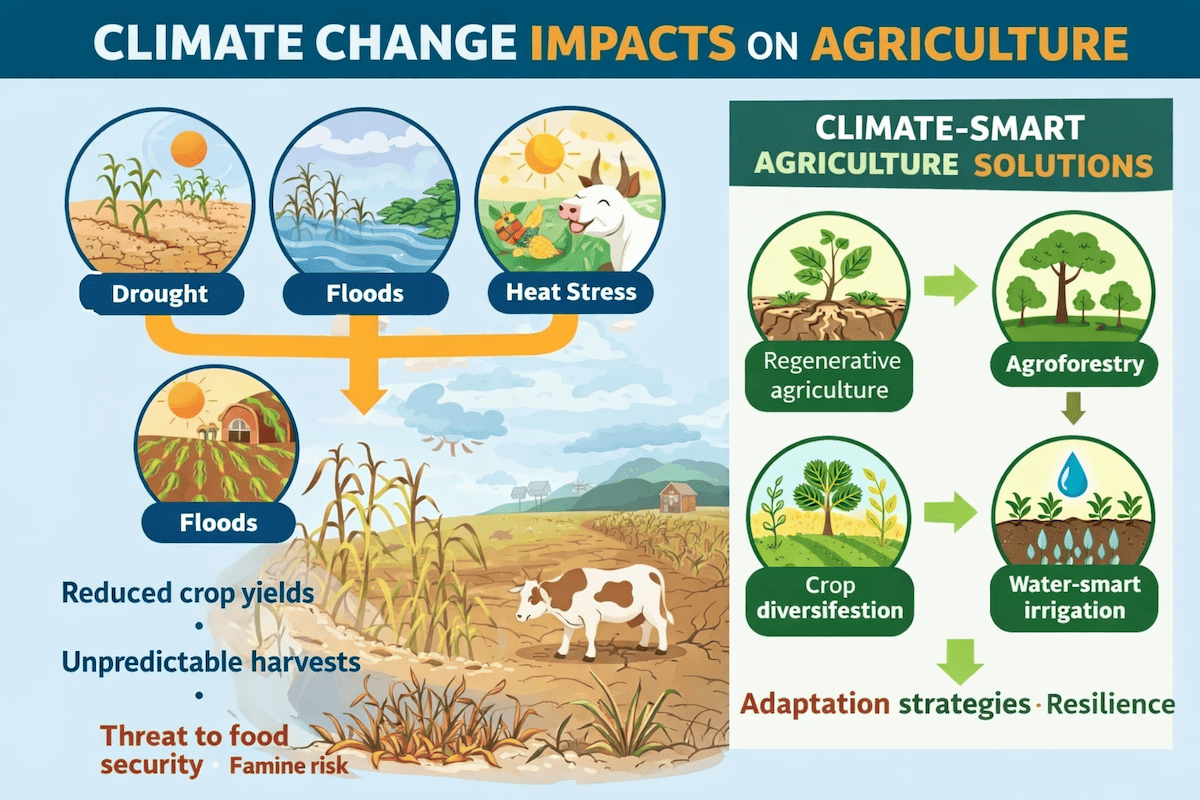
Climate change is transforming agriculture worldwide. Rising temperatures, shifting rainfall patterns, drought, flooding, and extreme weather events are already affecting crop production, livestock health, soil fertility, and global food security. Farmers are responding with climate-resilient techniques such as regenerative agriculture, agroforestry, water-efficient irrigation, and crop diversification to protect yields and build more sustainable food systems.
Agriculture depends heavily on stable climate conditions. When temperature, rainfall, and seasonal patterns change, the entire food production system can be disrupted—especially in climate-vulnerable regions and island communities working to strengthen food security. Understanding how climate change affects farming is essential for developing resilient agricultural practices capable of feeding a growing global population.
Share This Infographic
You are welcome to share this infographic on your website or blog.
Please include a link back to this page as the source.
How Climate Change Is Affecting Agriculture
Agriculture is one of the most climate-sensitive industries in the world. Crops, livestock, and soil ecosystems respond directly to changes in temperature, rainfall, and seasonal timing. As the climate shifts, farmers must adapt their practices to manage increasing environmental uncertainty—especially in regions already facing crises like drought and famine.
The most significant climate pressures currently affecting agriculture include rising temperatures, unpredictable rainfall, extreme weather events, expanding pest populations, and soil degradation. Many of these patterns show up clearly in shifting storm cycles and changing rainfall patterns that disrupt planting schedules, irrigation needs, and harvest timing.
Rising Temperatures and Crop Stress
Even small increases in temperature can significantly influence crop productivity. Many crops have optimal temperature ranges for growth, and when those thresholds are exceeded plants experience stress that can reduce yields. Heat can reduce pollination success, increase evaporation of soil moisture, and shorten growing seasons—forcing growers to rethink crop selection, planting windows, and shade strategies.
Livestock are also affected by rising temperatures. Heat stress can reduce milk production, lower fertility, and increase mortality during extreme heat events. As global temperatures rise, ventilation, shade, water access, and timing of grazing become increasingly important for animal health and farm profitability.
Changing Rainfall and Water Availability
Climate change is altering rainfall distribution across many agricultural regions. Some areas are experiencing prolonged drought conditions while others face heavier storms and flooding. Drought reduces soil moisture and water availability, limiting plant growth and decreasing yields, while intense rainfall can flood fields, erode topsoil, delay planting, and increase disease pressure.
Water-smart planning is now core to climate resilience. Farms are increasingly adopting rain capture, contouring, mulching, and storage strategies like those described in
rainwater harvesting techniques, along with crop planning that matches local rainfall realities.
Extreme Weather and Disaster Disruptions
Climate change is increasing the frequency and intensity of extreme weather events including hurricanes, storms, haboobs, floods, and heat waves. These events can destroy crops, damage infrastructure, and disrupt food supply chains. Floods can wipe out entire harvests, while prolonged heat waves can damage crops during critical growth stages.
Strengthening response capacity matters too—especially when communities need rapid support after climate shocks. Building practical readiness plans and local distribution partnerships can complement
disaster relief efforts and help restore food access faster.
Expanding Pest and Disease Pressure
Warmer temperatures allow many insects, pathogens, and crop diseases to spread into new regions. Pests that previously could not survive colder climates are now expanding their range, threatening crops that have little natural resistance. Farmers are seeing increased pest populations, rising input costs, and higher crop losses.
Soil Degradation, Productivity Loss, and the Case for Regeneration
Healthy soil is the foundation of productive agriculture. Unfortunately, many conventional farming practices have contributed to soil degradation through erosion, nutrient depletion, and loss of organic matter. Climate change accelerates soil degradation by increasing erosion from heavy rainfall and reducing soil moisture during drought.
Rebuilding soil health is one of the most effective strategies for improving climate resilience in agriculture. Practices such as composting, cover crops, reduced tillage, and biodiversity planting improve water retention and nutrient cycling—core elements of soil health and regenerative agriculture.
Climate-Resilient Agricultural Techniques
Despite these challenges, farmers and researchers are developing strategies that help agriculture adapt to changing environmental conditions. Many of these approaches focus on restoring ecological balance while improving farm productivity and local food access.
Regenerative Agriculture
Regenerative agriculture focuses on rebuilding soil health and restoring natural ecosystems. Practices such as composting, cover cropping, crop rotation, reduced tillage, and managed grazing increase soil organic matter and improve soil structure. Healthier soils retain more water, support beneficial microbes, and buffer farms against drought, flooding, and heat.
Agroforestry and Traditional Knowledge
Agroforestry integrates trees and shrubs into agricultural landscapes, providing shade for crops and livestock, reducing wind damage, improving soil fertility, and increasing biodiversity. Many climate-resilient practices also draw from time-tested methods rooted in place-based knowledge and traditional agriculture and cultural preservation.
Off-Grid and Resource-Efficient Farming
As climate impacts worsen, farms in remote or infrastructure-limited areas increasingly rely on resilient, low-dependency systems. Tools like gravity-fed irrigation, solar pumping, compost-based fertility, and backup water storage can improve stability—especially for those building resilience through an off-grid gardening approach.
Crop Diversification and Local Market Stability
Diversifying crops reduces risk in uncertain climates. Farms that grow multiple crops are less vulnerable to climate shocks than those relying on a single crop. Diverse systems can improve soil health, suppress pests naturally, and provide more stable income streams—especially when linked to strong local distribution networks and community support.
Community engagement is part of resilience. Programs that mobilize growers, volunteers, and local leaders—like Food Ambassadors, help strengthen neighborhood food access, education, and coordination during disruptions.
Food Systems Risk: When Climate Meets Geopolitics
Climate change doesn’t only affect farms—it affects supply chains, food prices, and political stability. Crop failures in key regions can contribute to shortages, inflation, and unrest. Understanding global pressure points—including issues covered in resource shortages and social unrest, helps communities plan for resilience at the local level.
Building a Climate-Smart Food Future
Climate change presents one of the greatest challenges agriculture has ever faced. Yet it also creates an opportunity to redesign food systems around soil health, water efficiency, biodiversity, and community readiness. By supporting growers and scaling proven climate-smart practices, we can protect food security while restoring ecosystems.
This is why initiatives that connect climate action to practical, scalable solutions matter. Learn more about our broader mission through the Food Planet Hero Initiative and explore how project models like Spiral Farms can help communities grow more food with less water and greater resilience.
Frequently Asked Questions
How does climate change affect crop yields?
Climate change can reduce crop yields through heat stress, drought, flooding, and more frequent extreme weather. Higher temperatures can disrupt pollination and plant development, while changing rainfall patterns can delay planting, increase disease pressure, and cause crop losses.
What are the biggest climate risks for farmers?
The biggest risks include rising temperatures, unpredictable rainfall, severe storms, flooding, and expanding pests and diseases. These shifts make growing seasons less reliable and can increase costs for irrigation, pest management, and recovery after weather-related damage.
What is climate-resilient (or climate-smart) agriculture?
Climate-resilient agriculture uses practices that protect yields under climate stress while improving long-term sustainability. This often includes water-efficient irrigation, diversified cropping, improved soil management, and regenerative approaches that build resilience to drought and extreme rainfall.
How does regenerative agriculture help with climate change?
Regenerative agriculture improves soil structure and organic matter, which increases water retention, reduces erosion, and supports healthier plant growth. By rebuilding soil health, farms can better withstand drought and heavy rainfall while also storing more carbon in the soil.
What can communities do to improve food security as climate impacts grow?
Communities can strengthen food security by supporting local growers, expanding water-smart growing methods, building emergency preparedness for supply disruptions, and investing in resilient local food systems. Practical steps include community gardens, local distribution partnerships, and education programs that increase participation and readiness.

.png)
.png)
.png)

.png)