Baton Rouge • Community Gardens • Urban Farming
Baton Rouge Community Garden & Urban Farming Initiative in Louisiana
Community gardens and urban farming in Baton Rouge help increase access to fresh food, strengthen neighborhoods, and create resilient local food systems across Louisiana.
Quick answer: A community garden and urban farming initiative in Baton Rouge focuses on growing fresh food locally, improving food access, and empowering residents through sustainable, space-efficient agriculture.
A community garden in Baton Rouge is a shared space where residents come together to grow fruits, vegetables, and herbs for personal use and community distribution. These gardens can be located in neighborhoods, schools, churches, parks, or underutilized urban spaces.
Definition: Urban farming is the practice of growing food within city environments using methods such as container gardening, raised beds, and small-scale agricultural systems adapted to limited space.
In Baton Rouge, community gardens play an important role in addressing food access challenges while also creating opportunities for education, collaboration, and local food production.
Did you know? Urban farming can transform vacant or underused land into productive food systems that supply fresh produce to local neighborhoods.
Why Urban Farming Matters in Louisiana
In Louisiana, many communities face challenges related to food access, health, and economic opportunity. Urban farming initiatives provide a way to grow fresh, nutritious food locally while reducing dependence on long-distance supply chains.
Baton Rouge’s warm climate and long growing season make it well-suited for year-round food production, especially when paired with efficient growing systems that maximize yield in small spaces.
Community gardens offer multiple benefits, including improved access to fresh food, stronger community connections, educational opportunities, and enhanced local resilience. They also create green spaces that improve neighborhood environments and support overall wellbeing.
By involving residents directly in food production, these initiatives help build skills, confidence, and a stronger sense of ownership over local food systems.
Growing To Give Initiative in Baton Rouge
The Growing To Give initiative supports the development of community gardens and urban farming systems that are scalable, efficient, and adaptable to different environments. By introducing water-smart, high-efficiency growing technologies, these gardens can produce more food while using fewer resources.
This approach helps ensure that communities can sustain long-term food production while creating opportunities for growth, education, and local economic development.
The vision: To expand community gardens across Baton Rouge—creating local food hubs that nourish families, strengthen neighborhoods, and build a more resilient Louisiana.
Weeks before Christmas, in the midst of the pandemic, a family of seven was evicted from their home. Despite a government moratorium on rent payments, the sheriff's cars rolled up early in the morning, and this family had fifteen minutes to grab what they needed and leave the house. It happened in small-town America. A community outside of Baton Rouge, Louisiana.
Good Samaritans stepped in and paid for a hotel room for the family. One room. Mother and father, their three children, and two young grandchildren.
The matriarch of the family, known for never giving up, collected her courage and went on a search for a new home. One she could move her family into before Christmas. Time ticked by, and there was nothing she could afford. She had $500. Three days before Christmas, she was driving to work, and a man removing a for rent sign from the roadside caught her eye. She turned around and followed the man to his home. She got out and introduced herself as Donna Butler. They stood looking at each other. She knew this was it. This property had to be the place her family could call home.
She asked what the rent was. Thirteen hundred dollars. She had five hundred. Five hundred she would have to use the next day to pay for another week at the hotel. Her little voice inside said, “tell him the truth.” She did. She explained the situation and told the landlord she only had $500. He looked at her and asked when she would have the first month’s rent. Again, the voice said, “tell him the 28th”, which was three days after Christmas. This was a truth she had no idea how she would prove out. Then he did something unexpected. He said yes, and gave her the keys to the house. They moved into their new home on five acres on Christmas Eve.
They celebrated the holiday, and as the pages of the calendar turned over, she and her daughter, Arielle, took every odd job they could find to raise funds to pay the landlord. On December 28th, the landlord arrived. The look of surprise on his face as she counted out the thirteen 100-dollar bills wiped away all her fear, and she knew she got a reprieve. She could breathe easier for another month.
A Family Journey
This family’s journey out of challenging circumstances is similar to thousands of families in Louisiana. This story of struggle is more common than not in communities across America. Growing to Give is stepping up and giving them the technology and tools needed to grow fresh food for their family and community. Together, we can significantly impact the community that, as Donna says, “is hungry.”
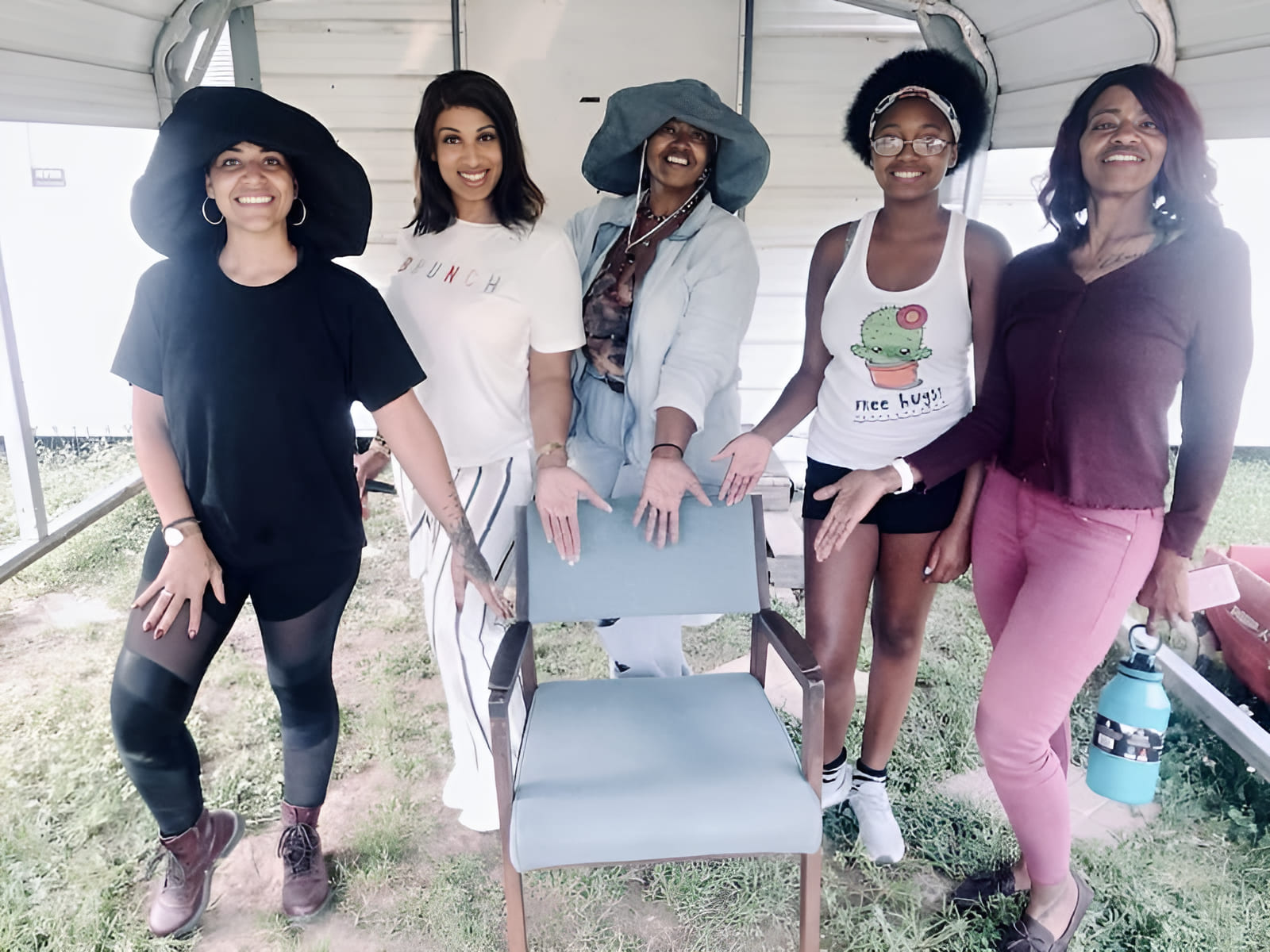
During this upheaval, her youngest daughter, Elle, was preparing to attend college. Her choice is agriculture school. She was awarded a scholarship to Southern University! In the spring of 2022, she wrote her mid-terms. That’s where the team from Crop Circle Farms and Growing to Give got an idea that would give Elle a headstart in her career in agriculture. The idea is to help Elle establish an urban farm on the 5 acres of land the family lives on now. Follow on our social media, where we are journaling her experience. With our guidance, Elle will be preparing to build a small-scale farm to feed the community. She needs the assistance of our non-profit and the knowledge and expertise of the Crop Circle Farm team and generous benefactors and volunteers. Open to volunteering time are entrepreneurs in the community like Patricia Jenkins of EveryBody’s Solution, members of the hit social media group, Black Girls Grow, and members of the non-profit Arielle’s Choice.
Growing To Give
Growing To Give supports families in need in Baton Rouge, Louisiana with fresh, nutritious produce grown locally. The farm serves to demonstrate Crop Circle farms and gardens to other farmers and in particular women in agriculture throughout the state who want to create a better life for themselves and their families.
Crop Circle Farms and Gardens
A large spiral, Crop Circle Farm will be placed in an open half-acre section of the property, partially to the sun and protected by broadleaf trees. The property location is prone to low surge flooding from periodic rainfall and, as such, is not suitable for below grade agriculture. Therefore, a raised structure to elevate plants 24 inches above the surrounding grade would be fabricated. A temporary timber box will be constructed to contain soil, plant root, and fertilizers.
A permeable ground cover is laid out over the soil and fastened in place to prevent removal from wind blow—an irrigation line threads between alternating openings for plants spaced along the line. Irrigation maybe used intermittently given the predictable precipitation of Louisiana.
Collards are the crop of choice, and Georgia is the preferred variety. Georgia Southern Collards produce a very high yield of dark blue-green cabbage-like leaves and are slow to bolt and non-heading. This variety tolerates heat, humidity, and poor soil conditions making it an ideal vegetable crop for Louisiana.
As the farm expands, the team will place Crop Circle Gardens in an open 30-foot section of the property to grow vine crops like tomatoes and watermelon. Similarly, the gardens will be raised to elevate plants and roots above the high-water table and periodic flooding; therefore, the root area will be hilled and topped. A mound approximately 6 feet around and 30 inches high will be fashioned from soil mixed with fertilizer for each site, and each mound is topped (flattened) for insertion of the Crop Circle Garden.
A permeable ground cover is laid out over the raised mound and the surrounding grade to prevent weed growth. Gardens can optionally be connected to a “garden hose” irrigation system to water the plants.
For local insights on community health and food access programming in Louisiana, visit the LSU AgCenter Healthy Communities initiative.

.png)
.png)
.png)

.png)