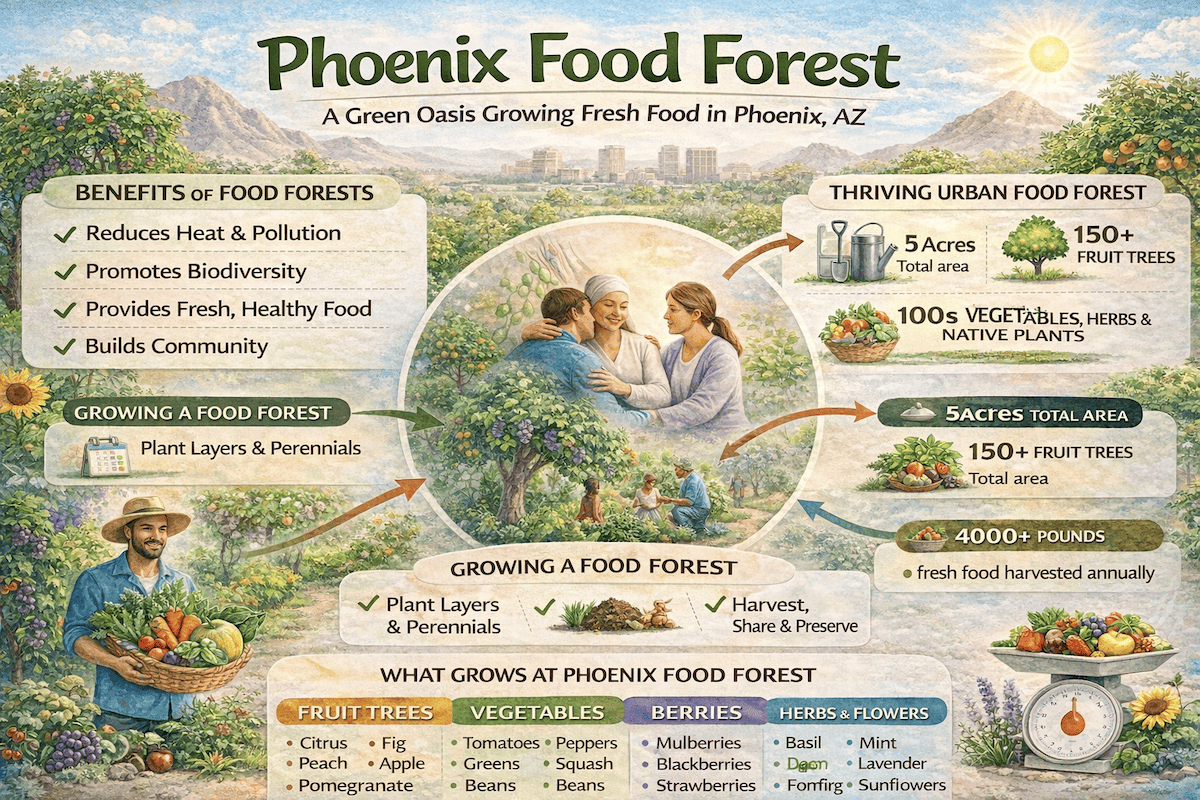
Phoenix Food Forest Initiative: Urban Agriculture & Edible Landscapes in the Desert 🌵
Discover how the Phoenix Food Forest Initiative is transforming urban neighborhoods into water-smart edible landscapes—growing fruit trees, cooling communities, and strengthening food security across the desert.
Phoenix Urban Food Forest Initiative: Growing Food in the Desert 🌵
Food forests in Phoenix use layered, water-efficient planting systems to grow food, cool urban environments, and strengthen local food security in desert climates.
Quick answer: A Phoenix food forest is a multi-layered urban growing system that uses trees, shrubs, and ground crops with water-smart design to produce food while conserving water and improving local ecosystems.
What Is a Phoenix Food Forest?
A Phoenix food forest is an urban agroforestry system designed for desert environments, combining fruit trees, herbs, vegetables, and perennial crops in layered plant communities that mimic natural ecosystems.
Definition:Food forests are multi-layered planting systems that integrate canopy trees, understory crops, soil-building practices, and water-efficient irrigation to create resilient, self-sustaining food ecosystems.
In hot, arid regions like Phoenix, these systems must be carefully designed to handle extreme temperatures, limited rainfall, and high evaporation rates.
Did you know? Food forests can create cooler microclimates by providing shade, reducing heat absorption, and improving soil moisture—helping combat urban heat in desert cities.
By combining drought-tolerant species, drip irrigation, deep mulching, and layered canopy design, Phoenix food forests can produce food while using significantly less water than traditional agriculture.
These systems transform underused urban land into productive green spaces that provide fresh food, support biodiversity, and create community gathering areas aligned with initiatives such as
USDA urban agriculture programs.
The Phoenix Urban Food Forest Initiative demonstrates how regenerative design and water-smart agriculture can turn even the harshest climates into productive, resilient food systems.
How Food Forests Work in Desert Climates
Designing a food forest in a desert climate such as Phoenix requires careful planning to balance food production with water conservation. Unlike temperate food forests that rely heavily on rainfall, desert food forests depend on thoughtful layering, soil building, and efficient irrigation systems to create resilient growing environments. When designed correctly, these systems mimic natural ecosystems while producing fruit, herbs, and vegetables with far less water than traditional landscaping.
Canopy Shade and Layered Planting
One of the most important strategies in desert food forest design is the use of canopy trees to create shade and protect understory plants. Larger trees reduce soil temperatures, slow evaporation, and create cooler microclimates that allow smaller crops to thrive. Over time, a layered structure forms that includes canopy trees, mid-level fruit trees, shrubs, herbs, and groundcovers. This natural layering improves ecosystem stability and reduces water stress during the intense Arizona summer heat.
Water Efficiency with Drip Irrigation
Efficient irrigation is essential for sustainable desert agriculture. Most desert food forests rely on drip irrigation systems connected to timers or water tanks. These systems deliver water directly to plant root zones, minimizing evaporation and runoff. Drip irrigation allows trees and crops to receive consistent moisture while using significantly less water than traditional sprinkler systems. In many cases, irrigation can be combined with rainwater harvesting and passive water basins to further improve water efficiency.
Deep Mulch and Soil Protection
Mulching is another critical component of desert food forest design. Thick layers of organic mulch such as wood chips help insulate the soil, retain moisture, suppress weeds, and improve long-term soil fertility. Over time, mulch breaks down and feeds beneficial soil organisms, increasing the soil’s ability to hold water and nutrients. This process gradually transforms compacted urban soil into rich, living soil capable of supporting diverse plant life.
Healthy Soil Microbes
Healthy soil is the foundation of any productive food forest. Soil microbes—including bacteria, fungi, and mycorrhizae—form complex relationships with plant roots that help plants absorb nutrients and water more efficiently. Compost, worm castings, and organic matter support these microbial communities and accelerate soil regeneration. As microbial life increases, the soil becomes more resilient to drought, extreme heat, and nutrient depletion.
Drought-Tolerant Food Forest Species
Selecting plants that naturally tolerate heat and drought is essential for long-term success in desert environments, especially areas susceptible to occasional haboobs. Many fruit trees and perennial crops are well adapted to Phoenix’s climate and can thrive with proper care and irrigation. Species commonly used in desert food forests include pomegranate, fig, olive, jujube, mulberry, prickly pear cactus, and mesquite. These plants provide fruit, shade, habitat for pollinators, and in some cases edible pods, leaves, or flowers.
Creating Microclimates
As trees grow and vegetation layers develop, small protected zones known as microclimates begin to form. These shaded pockets reduce wind exposure and temperature extremes, allowing more delicate plants to grow successfully. Herbs, vegetables, and seasonal crops can often be planted beneath established trees where the soil remains cooler and moisture is retained longer. Over time, these microclimates allow desert food forests to support greater biodiversity and more consistent food production.
Through canopy shade, water-efficient irrigation, soil regeneration, and climate-appropriate plant selection, desert food forests demonstrate how productive agriculture can exist even in hot, dry environments. These systems transform underutilized urban spaces into resilient landscapes that produce food, support wildlife, and strengthen community food security.
Benefits of Urban Food Forests
Urban food forests provide far more than just fresh produce. By combining trees, shrubs, herbs, and groundcovers into layered edible landscapes, these systems deliver a wide range of environmental, social, and economic benefits. In cities like Phoenix, food forests can help address food access challenges, reduce urban heat, improve soil health, and strengthen neighborhood connections while transforming underused spaces into productive green infrastructure.
Benefit
Impact
Food Security
Local access to fresh fruits, herbs, and vegetables grown within the community.
Urban Cooling
Tree canopy and vegetation help reduce the urban heat island effect by providing shade and lowering surface temperatures.
Water Conservation
Mulch, drip irrigation, and soil regeneration improve water efficiency compared to traditional landscaping.
Biodiversity
Food forests attract pollinators, birds, and beneficial insects, restoring ecological balance in urban environments.
Community Building
Residents collaborate on planting, harvesting, and maintaining shared green spaces that strengthen neighborhood connections.
When implemented thoughtfully, urban food forests become living systems that support both people and ecosystems. They demonstrate how cities can integrate agriculture, ecology, and community engagement to create healthier and more resilient neighborhoods.
The Phoenix Urban Food Forest Initiative, led by Christopher Macy, aims to transform underutilized urban spaces into thriving, sustainable food forests. This project began in March 2020 on his property as a proof of concept, inspired by Ron Finley in Los Angeles, and developed while working from home during the COVID-19 pandemic. The project now includes seven parkways with 160+ fruit trees for the neighborhood.
About the Phoenix Urban Food Forest Project
The Phoenix Urban Food Forest Initiative is part of the Growing To Give network of regenerative agriculture and food security programs. The project demonstrates how urban neighborhoods can integrate fruit trees, edible landscapes, and permaculture systems into city infrastructure to improve access to fresh food while restoring soil and biodiversity.
Our mission is to provide fresh, organic produce to local communities, promote environmental stewardship, and educate residents about sustainable agricultural practices. Our long-term goal is to create the largest urban food forest in the United States. The starting scope of the project is from 35th Ave to 37th Ave and from Van Buren St to Roosevelt St, encompassing 20 acres of urban parkways that the city owns but homeowners are responsible for maintaining. This project will progress block by block until completion, implementing water tanks with drip lines and automated timers to conserve water. Future programs will be established in local neighborhood schools to teach students how to start agricultural businesses and learn about food sustainability.
Our Goal - Edible Landscapes
To cultivate sustainable urban food forests in Phoenix, Arizona, providing fresh produce and educational resources to local communities.
Share This Infographic
You are welcome to share this infographic on your website or blog.
Please include a link back to this page as the source.
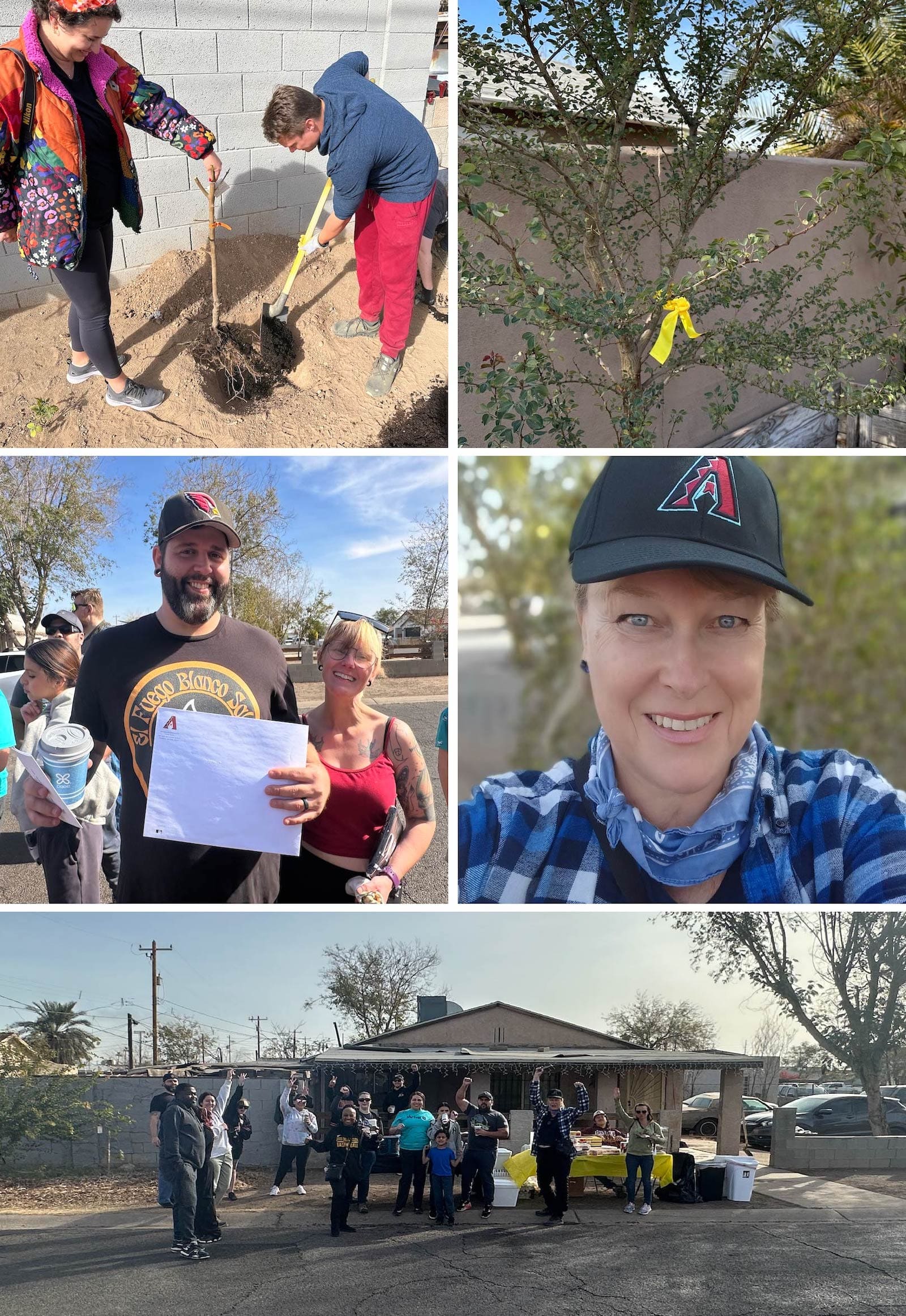
We are thrilled to announce that, as of Feb 1, 2025, we are now home to the largest food forest in the country, stretching across several streets and byways in Phoenix. Our Planting Day event was a huge success, thanks to the incredible volunteers and sponsors who came together to make it happen. Our co-founder, Siobhan Shaw, shares her sights and sounds of the day here:
“I remember rolling in, and the first thing I saw was a massive banner from our friends at Kwik Signs on the corner, where the team had set up the welcome and food tables. The music was rocking, people were chatting, and the energy of the day was just beginning.
It's what I love most about our community events—people coming together to help others. There's a special, energizing feeling in the air, and the enthusiasm is contagious. There’s nothing quite like it. Volunteers filtered in, and the team, led by Christopher Macy, began directing volunteers to the various parkways where holes had been pre-dug for the fruit trees and seasonal vegetables like peppers and broccoli. The sounds of families, couples, children, teens, and even the neighborhood dogs barking with excitement filled the air.
Wheelbarrows and shovels moved in unison to the beat of the loudspeakers playing favorite tunes. I caught a ride in a vintage farm truck, which reminded me of a previous community farm project during the pandemic. A beautiful sunny day set the perfect backdrop for the event's success. We grabbed a slice of pizza from NYPD Pizza, coffee and baked goods from Bacio’s, coffee from The Copper Gila Cafe, bagels from Einstein Bros Bagels, subs from Jimmy John's, water, pop, tortilla chips, and donuts from anonymous donors. We made new friends. We all promised to come back for the next event on Earth Day to teach children how to grow food in containers at Chase Field with our friends at the Arizona Diamondbacks.
All of this stems from the vision of Christopher Macy, a Navy veteran and neighborhood resident. He and his wife have done an incredible job hosting the even. I’ve gained another “mama”—Christopher’s mother-in-law, who handled the food table with love, grace, and a mother’s care, making sure we all had something to eat. We ate well, thanks to the amazing lineup of sponsors, including delicious homemade salsa from El Fuego Blanco Salsa.
I proudly wore my new farm hat, a gift from the Arizona Diamondbacks, with their logo emblazoned front and center, and pulled on my new Wounded Warriors tee. I spent the day following the action with my camera, capturing memories and smiling faces, and left with my heart full of love for this amazing community. I chatted with the team from Local First Arizona, who were there snapping pictures and sharing the stories of the day with their readers.
Lots of laughter and cheers rang through the street as we began calling ticket numbers for generous gifts from local restaurants (listed in the carousel below), gift bags with natural spa goodies from Annabelle’s Natural Skincare, 4Life.com affiliate (promo code G2G), a gift certificate from celebrity detox doctor, Dr. Roni Deluz, and to top it off, Arizona Diamondbacks hats to match mine and four tickets to great seats behind the dugout!
Neighbors from a few blocks away approached our team to ask if we could plant in front of their homes. Others stopped to tell Christopher that they had beleived in him from the beginning of the project, almost 5 years ago. Together, we’re growing a street plantation of trees—guava, olives, desert apples, jujube fruit (red date), and others—along with a community of friends, all united in improving food security, one block at a time.
With 160 fruit trees, 20 acres of parkways ahead of us, and numerous flowers and vegetables, we enter the desert Spring with hopes for rain to break the almost half-year drought, and gratitude for the new water truck outfitted with a tank to ensure the plants and tree saplings from Elgin Nursery and Tree Farm and The Urban Farm thrive. Year after year, these trees will grow, creating a city of Phoenix neighborhood east of downtown filled with chirping birds and busy pollinators making sweet music, led by Christopher’s rooster’s cock-a-doodle-doo. The trees provide nourishment and shade for the neighborhoods, habitat for the birds, bringing back a sense of community where children can safely play on the streets, families gather for barbecues, and good cheer is the beverage of the day.
"The most important thing is trying to bring a little bit of balance between urban and rural so that people who live in cities understand where their food comes from…and people can have fresh, clean food right outside their house."
We Are On A Mission To:
1. Increase Food Security: Provide fresh, organic produce to underserved communities living in food deserts and form future partnerships
with the nearby food bank.
2. Environmental Sustainability: Promote biodiversity and sustainable land use practices by integrating food
systems directly into neighborhoods where people live.
3. Community Engagement: Involve Phoenix residents in the planning, development, and maintenance of food forests.
As the project progresses, establish neighborhood food markets to generate much-needed income for lower-income
communities.
4. Educational Outreach: Offer workshops and resources on sustainable agriculture and environmental stewardship.
Create partnerships and educational food sustainability programs for Alta E. Butler Elementary School, Carl T.
Smith Middle School, and Carl Hayden High School. Plant fruit trees and vegetables for students to learn to care
for, harvest, and cook with in school cafeterias. Teach students how to create businesses selling produce,
landscaping services, worm castings, and seeds.
Key Components
1. Site Selection and Preparation
• Starting from 36th Ave and Fillmore St, we are almost to 36th Ave and McKinley St, progressing
north on both sides of the street parkways. This will continue block by block, moving north, south, east, and west
until every parkway neighbor has given permission for planting, covering from 35th Ave to 37th Ave and Van Buren
St to Roosevelt St.
• In the future, with funding, we will conduct soil testing and remediation by adding worm
castings and creating an environment for Mycorrhizae to grow.
• Rebuilding Life Gardens LLC will begin by planting native fruit trees and layering in-ground
vegetables as the fruit tree canopy develops over the years and soil conditions improve.
2. Planting and Cultivation
• The project has started with Arizona-native fruit trees and desert trees that can handle the
summer heat. These include fruit trees such as citrus, pomegranates, olives, mulberries, prickly pear cacti, figs,
apples, plums, Barbados cherries, sugar cane, and more.
• With funding, we will implement permaculture principles to create a self-sustaining ecosystem.
We have partnered with Growing to Give and will utilize technological systems such as crop circles where possible,
automated drip lines attached to water tanks, and wood chips/mulch for water retention and soil remediation.
• We utilize organic and regenerative agricultural practices, primarily focusing on permaculture.
This involves recreating what nature does naturally and allowing beneficial insects, birds, and local wildlife to
come into the ecosystem.
3. Community Involvement
• With funding, we will organize volunteer days for planting and maintenance with private
organizations and local neighbors to benefit from the project.
• Establish a community advisory board to guide project development. Growing to Give has agreed
to provide oversight, support, and guidance as the project grows.
• Create educational programs for schools and community groups within the neighborhood and city
of Phoenix.
• Incorporate composting and mulching to enrich the soil.
• Monitor and adapt practices to enhance ecosystem health.
Get Involved, Volunteer, Partner, Donate
Frequently Asked Questions
Can food forests grow in the Arizona desert?
Yes. With drought-tolerant species, mulch, drip irrigation, and layered planting, food forests can thrive even in hot desert climates like Phoenix.
How much water does a desert food forest use?
Food forests typically use less water than traditional landscaping because shade trees reduce evaporation and drip irrigation delivers water directly to plant roots.
The Arizona Diamondbacks actively promote sustainability through various initiatives, such as the
"Break a Bat, Plant a Tree" program, which provides desert-adapted shade trees in local parks [MLB.com]. At
Chase Field, they have implemented eco-friendly practices, including the installation of solar panels
and a vertical garden, to reduce their environmental footprint. The Diamondbacks support the Phoenix
Urban Food Forest Initiative created by Growing To Give [GrowingToGive.org].
The Wounded Warrior Project (WWP) is a nonprofit organization dedicated to supporting wounded
veterans and their families through various programs that address physical, mental, and economic
challenges. WWP provides rehabilitation services, career counseling, peer support networks, and
adaptive sports programs to help veterans reintegrate into civilian life. Additionally, the
organization funds and collaborates on community initiatives that provide housing, mental health
resources, and financial assistance to injured service members. By advocating for veterans' needs at
both local and national levels, WWP ensures long-term support for those who have served.
Jimmy John’s supports sustainability through initiatives focused on responsible sourcing, waste
reduction, and energy efficiency. The company prioritizes using fresh, locally sourced ingredients
whenever possible, reducing its carbon footprint by minimizing transportation emissions. Additionally,
Jimmy John’s has implemented eco-friendly packaging, with an emphasis on recyclability and
compostability. Efforts to reduce food waste include streamlined inventory management and donating
surplus food when feasible. Furthermore, the brand has taken steps to improve energy efficiency in its
restaurants, incorporating LED lighting and energy-efficient appliances to lower overall environmental
impact.
Einstein Bros. Bagels demonstrates its commitment to sustainability through various initiatives,
including the exclusive use of cage-free eggs in all egg sandwiches since 2017. The company is also
working towards achieving a fully cage-free egg supply chain for all its brands. Additionally,
Einstein Bros. Bagels has implemented energy-efficient lighting, power conservation measures, and HVAC
system upgrades to reduce its environmental footprint. In terms of community support, Einstein Bros.
Bagels offers a fundraising program that allows qualifying organizations to purchase bagels at a
discounted rate, enabling them to raise funds effectively.
AZFirst's mission is to carry out charitable work in the community with a strong emphasis on
inspiring young students in an appreciation of science and technology.
Conveniently located in Phoenix, AZ, we serve the entire Grand Canyon State. From conception to
completion, Kwik Sign Letters is here to assist you with sign solutions. It is important that you get
the right sign and design for your purpose and company, which is why you will benefit from our 28+
years of combined experience in the sign and electronics industry. Whether you know exactly what you
need or are just looking for a place to start, you have come to the right place. Developing a
communication strategy through signs is what we do best. We also enjoy helping our customers learn the
benefits of employing different techniques and ways of displaying their information. Our team will
provide you with the knowledge you need to be successful with your goals. We guarantee satisfaction
and work hard for every customer, no matter how big or small the project is.
Elgin Nursery and Tree Farm is a retail and wholesale tree and plant nursery that has been serving
the Phoenix Metro area since 1986. Our trees and shrubs are locally grown at our farm. We are a proud
member of the Arizona Nursery Association. Our nursery is located north of I-10 and east of Loop 101
Agua Fria Freeway at 8606 W. McDowell Road.
Hungry for Downtown Phoenix pizza? We have great news: we just opened up a new location on the
northeast corner of 7th Ave. and McDowell. Call us for Downtown Phoenix pizza delivery or stop by our
brand new location for authentic New York flavor you can’t get from any other Phoenix pizza company.
Just try a slice – we’re sure you’ll be an NY Pizza Department believer after the very first bite. So
next time you’re hungry in the Downtown Phoenix area, we’ve got you covered! We support the Food
Forest project in East Phoenix.
The Copper Gila Café is a Phoenix-based mobile espresso and tea catering service specializing in
corporate and private events, including weddings, open houses, and customer appreciation gatherings.
As a multi-roaster company, they source high-quality coffee from local Valley roasters, ensuring each
cup is brewed with care. Their offerings include organic fair-trade espresso beans, Maya Chai Tea, and
a selection of syrups from brands like 1883 or Monin. The café provides various service packages
tailored to event sizes, featuring friendly baristas and options for both regular and decaf espresso,
as well as milk alternatives like oat milk. Their mission is to celebrate and connect with clients
while serving delicious beverages at conferences, corporate events, weddings, and similar occasions.
Rebuildinglifegardens.com is a veteran owned business. After getting out of the Navy my life passion
was to help honor as many veterans as possible and plant as many fruit trees as possible so
communities can have access to clean health food. I have seen over the past 3 years how this brings
the community together. In our shop you can purchase fruit trees to honor you veteran or activity duty
military family or loved ones. By doing this you become a hero honoring our military, sharing their
stories, and helping feed those who most need it.
Fresh Produce and Seed
Annabelle's Natural Skin Care is a Mesa-based company that formulates and shares all-natural,
vegetable and botanical-based skin care products. FACEBOOK.COM Their offerings include handmade skin
and hair care items crafted with quality ingredients designed to nourish, moisturize, and renew. ANNABELLEPERFECTBLEND.COM Additionally, Annabelle's Natural Skin Care
participates in local markets, such as the Farm to Mesa Market, to engage with the community and
showcase their products.
El Fuego Blanco Salsa is a brand specializing in a variety of hot salsas, known for their bold,
flavorful blends that cater to different spice levels, from mild to extremely hot, using a mix of
fresh peppers like jalapeño, serrano, and habanero, ensuring a fiery kick with each bite while
maintaining a balanced taste profile, making it a popular choice for those seeking to add an extra
punch to their meals, whether it be on tacos, chips, or as a condiment.
The Urban Farm in Phoenix, established by Greg Peterson, serves as a central hub for urban
agriculture education and practice. Located on a third of an acre, it features an entirely edible
landscape, including over 80 fruit trees, vegetable gardens, and innovative systems like aquaponics
and rainwater harvesting. Through online courses, podcasts, and local events, The Urban Farm educates
individuals on sustainable food production, aiming to inspire a shift towards decentralized,
city-based agriculture. This initiative not only provides fresh produce but also fosters community
engagement and environmental stewardship.
Colorado auto repair shops offer a wide range of services, from routine maintenance like oil changes
and tire rotations to complex engine diagnostics and transmission repairs. With the state's varying
climate and mountainous terrain, many mechanics specialize in handling issues related to extreme
weather conditions, such as cold-weather engine performance, brake wear from steep descents, and
off-road vehicle maintenance. Whether at independent garages, dealership service centers, or
specialized repair shops, Colorado drivers can find skilled technicians equipped with the latest tools
and technology to keep their vehicles running smoothly.
Heartfelt Hearing Center, located at 6740 E University Dr Suite 109 in Mesa, Arizona, is a
family-owned clinic dedicated to providing high-quality hearing aids and repair services. Led by Lisa
Galliher, a third-generation native of Phoenix with over 15 years of experience in hearing healthcare,
the center offers state-of-the-art equipment, including video otoscopy for detailed ear examinations.
Patients have praised the clinic for its excellent service and personalized care, with one noting, "I
have been coming here for over 2 years. Service is excellent. Now that medical issues are affecting an
ear, I am glad Lisa is in my corner to help." The center's commitment to improving patients' quality
of life through better hearing and communication makes it a trusted choice for those seeking hearing
care in the Phoenix area.
Hendrix Salvage Company Inc., located at 3125 S. 51st Avenue in Phoenix, Arizona, has been serving
the surplus equipment market for over 15 years. The company specializes in purchasing a wide variety
of equipment, providing an outlet for businesses to recover maximum value for their unused or outdated
items. Additionally, Hendrix Salvage has expanded its operations to include a comprehensive scrap
metal recycling division, handling materials such as steel, copper, brass, aluminum, stainless steel,
radiators, wire, and aluminum cans. They offer services to both companies and the public, with options
for on-site pickup or delivery to their 28-acre facility. The company operates Monday through Friday
from 7:00 AM to 4:30 PM, and on Saturdays from 7:30 AM to 1:00 PM.
The Arrogant Butcher in Phoenix is a popular upscale American restaurant located in the heart of
downtown at CityScape. Known for its stylish yet inviting ambiance, it offers a diverse menu featuring
high-quality steaks, seafood, and classic comfort foods with a modern twist. The restaurant is a
favorite among business professionals, sports fans, and food enthusiasts, providing a lively
atmosphere with craft cocktails, an extensive wine list, and a raw bar. Whether for a power lunch,
happy hour, or a night out, The Arrogant Butcher delivers a refined yet approachable dining experience
in the vibrant core of Phoenix.
Rosso Italian is a contemporary Italian restaurant located at 2 E Jefferson St, Suite 113, in
downtown Phoenix, Arizona. The restaurant offers a modern twist on premium Italian cuisine, drawing
inspiration from global flavors and influences. The menu features a curated selection of carefully
crafted entrées, appetizers, seafood, and their signature Napoletana pizza, all made with fresh,
high-quality ingredients. The interior design is sleek and rustic, with a touch of Italian warmth,
creating an inviting atmosphere for guests. Rosso Italian is open daily for lunch from 11:00 AM to
4:00 PM, with happy hour available Monday through Friday from 3:00 PM to 6:00 PM. Reservations can be
made through their website or by calling (602) 218-6001.
Fox Restaurant Concepts, founded in Phoenix, Arizona, by restaurateur Sam Fox, is a hospitality group
known for its innovative and diverse restaurant brands. The company has developed numerous popular
concepts, including The Henry, Flower Child, North Italia, and Culinary Dropout, each offering a
unique dining experience that blends high-quality food with stylish atmospheres. Fox Restaurant
Concepts has played a significant role in shaping Phoenix’s culinary scene and has expanded
nationally, attracting attention for its trendsetting approach to casual and upscale dining. In 2019,
The Cheesecake Factory acquired the company for $353 million, though it continues to operate with its
distinctive creative vision.
Barrio Café is the vision of owners Wendy Gruber and Chef Silvana Salcido Esparza. Since 2002, Barrio
Café has been the celebrated home to Chef Silvana Salcido Esparza. Here, her unique cuisine serves to
elevate Mexican American culture. Chef Silvana's versions of regional Mexican favorites are recognized
as some of the best Mexican cuisine in Phoenix, the region and nationally. Some iconic menu items
include Cochinita Pibil, Chiles en Nogada, and Chef's tableside Guacamole.
















.png)
.png)
.png)

.png)