Soil Health & Regenerative Agriculture: Build Living Soil for Stronger Crops
Regenerative agriculture improves soil health using cover crops, compost, reduced tillage, and biodiversity to increase fertility, water retention, and long-term productivity.
Soil Health • Regenerative Agriculture • Living Systems
Soil Health and Regenerative Agriculture: Building Living, Productive Soil 🌱
Soil health is the foundation of productive agriculture, and regenerative practices restore soil biology, improve structure, and increase long-term food production resilience.
Quick answer: Soil health improves through regenerative practices like composting, cover crops, reduced tillage, and biodiversity, creating living soil that supports plant growth, water retention, and long-term fertility.
What Is Soil Health?
Soil health refers to the biological, chemical, and physical condition of soil that allows it to function as a living ecosystem—supporting plant growth, cycling nutrients, storing water, and sustaining life above and below ground.
Definition:Soil health is the capacity of soil to function as a living system that sustains plants, animals, and humans while maintaining environmental quality.
Healthy soil is not just dirt—it is a complex, living community made up of minerals, organic matter, fungi, bacteria, insects, worms, roots, air, and water, all working together to support plant life.
Did you know? A single teaspoon of healthy soil can contain billions of microorganisms, forming one of the most complex ecosystems on Earth.
Regenerative agriculture builds on this living foundation by restoring organic matter, improving soil structure, increasing biodiversity, and enhancing the land’s ability to produce food year after year.
Rather than extracting nutrients until soil becomes depleted, regenerative systems focus on rebuilding fertility through natural processes—aligning with ecological principles often described in agroecology.
This approach is increasingly important as growers respond to challenges such as erosion, drought, and the pressures outlined in
climate change and agriculture.
Soil health also connects directly to food quality, water efficiency, and climate resilience. Lessons from highly fertile regions such as
prairie black soil and
Ukrainian soils
demonstrate the long-term value of organic matter and biological activity.
Whether applied on large farms, urban gardens, or systems like
root tube gardens, the principle remains the same: healthy soil creates healthier plants, ecosystems, and communities.
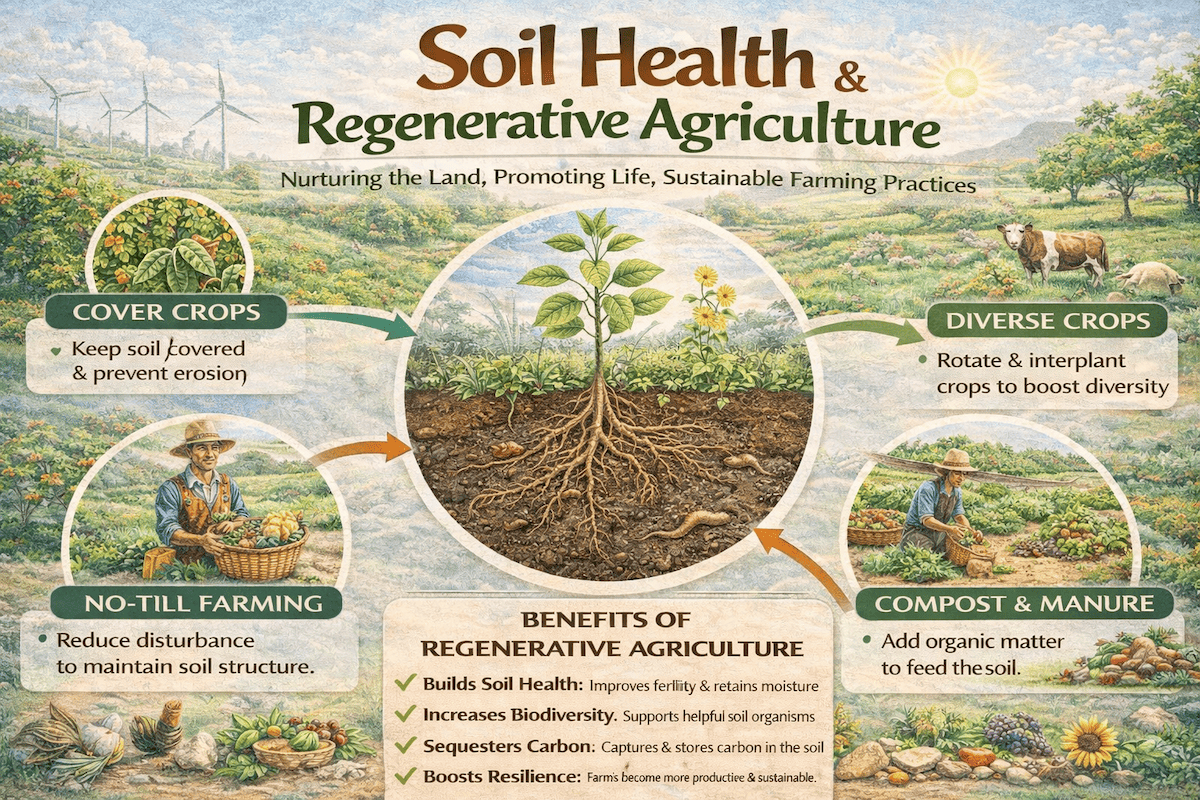
Share This Infographic
You are welcome to share this infographic on your website or blog.
Please include a link back to this page as the source.
Why Soil Health Matters
Soil is the base layer of nearly every terrestrial food system. When soil loses organic matter, becomes compacted, or is stripped of microbial life, the entire agricultural system becomes weaker. Water runs off instead of soaking in. Nutrients leach away rather than cycling through the food web. Crops become more dependent on outside inputs. Weeds, pests, and disease often become harder to manage. Over time, degraded soil leads to lower yields, weaker plants, greater irrigation demands, and greater vulnerability during weather extremes.
Healthy soil behaves very differently. It stores water like a sponge, releases nutrients gradually, supports beneficial microbes, and encourages strong root development. It is friable, biologically active, and full of life. One of the clearest examples of this biological richness can be found in the role of worms and decomposers. Materials like worm castings are valuable because they concentrate plant-available nutrients, beneficial microbes, and stable organic matter in forms that improve both fertility and soil structure. In living soil, fertility is not simply poured on from above; it is generated and cycled within the system itself.
Soil health is also essential for water management. As organic matter increases, the soil becomes better at holding moisture and allowing rainfall or irrigation to infiltrate instead of running off. This is especially important in dry climates and drought-prone regions, where every gallon of water matters. Strong soil structure can reduce erosion, buffer plants against heat stress, and lower the need for repeated irrigation. In practical terms, healthier soil often means lower costs, stronger crops, and greater resilience in both farms and gardens.
Core Principles of Regenerative Agriculture
Regenerative agriculture includes a variety of techniques, but most successful systems are built around a few consistent principles. The first is to disturb the soil as little as possible. Excessive tillage breaks apart soil aggregates, speeds oxidation of organic matter, harms fungal networks, and exposes bare soil to erosion. By reducing tillage, growers protect soil structure and allow microbial communities to recover.
The second principle is to keep soil covered. Bare ground loses moisture, overheats, and becomes vulnerable to erosion. Mulch, crop residue, living groundcovers, and cover crops all help moderate temperature, protect soil life, and reduce evaporation. A covered soil surface creates more stable conditions for roots, fungi, insects, and decomposers.
The third principle is diversity. Nature rarely relies on monocultures, and resilient agricultural systems tend to mirror that pattern. Crop rotation, interplanting, hedgerows, flowering borders, and mixed-species plantings help break pest cycles, improve nutrient exchange, and support pollinators and beneficial insects. This idea also connects with broader design strategies found in projects like the spiral farm project, where layout, plant selection, and ecological function are designed to work together rather than in isolation.
The fourth principle is feeding the soil food web. Compost, green manures, crop residues, worm castings, and biologically rich mulches add organic matter and support microbial life. Instead of treating fertility as a synthetic input problem, regenerative agriculture treats it as a biological process. Nutrients become more stable, more available, and more efficiently used when they move through living soil systems.
Growing Healthier, More Nutritious Plants
Healthy soil produces healthier plants because roots can access balanced nutrients, oxygen, moisture, and biological support. When soil structure is sound and microbial life is abundant, plants are often better able to take up minerals and defend themselves against stress. This can translate into improved flavor, stronger growth, and more resilient harvests. It can also reduce the need for synthetic fertilizers and pesticides by improving the natural functioning of the ecosystem.
Building Biodiversity Above and Below Ground
Regenerative agriculture is a biodiversity strategy as much as it is a farming strategy. Below ground, bacteria, fungi, nematodes, arthropods, and earthworms build the biological engine of fertility. Above ground, diverse plantings support pollinators, birds, predatory insects, and habitat stability. These connections matter because agriculture is not just about plants in rows. It is about creating conditions where life supports life. This is one reason regenerative agriculture often overlaps conceptually with the ecological wisdom described in traditional agriculture and cultural preservation, where long-term stewardship, diversity, and respect for place are central values.
Strengthening the Natural Environment
Regenerative practices do not simply minimize damage; they actively improve environmental function. By increasing organic matter and protecting ground cover, they can reduce runoff, improve infiltration, lower erosion, and increase carbon storage in the soil. Landscapes with healthy soil and diverse plant communities are often better able to recover from weather extremes, maintain water cycles, and support wildlife. These gains matter on working farms, but they also matter in community food projects and localized initiatives where agriculture is tied directly to health and food access.
Natural Fertility Instead of Input Dependency
A key principle of regenerative farming is to collaborate with natural cycles rather than depend entirely on purchased inputs. Composting, green manures, nitrogen-fixing cover crops, mulch decomposition, and biological soil amendments help maintain fertility in ways that build long-term health instead of merely delivering short-term feed. This approach supports sustainability because it reduces dependency while improving function over time. It also creates more resilient systems during periods of economic volatility or supply disruption.
Regenerative Agriculture and Community Resilience
Soil health is not only a farm issue. It is a community resilience issue. When local food systems are rooted in healthy soils, communities are better positioned to produce reliable, nutritious food closer to where people live. This reduces dependence on fragile supply chains, lowers transportation burdens, and creates educational opportunities around food, ecology, and stewardship. Projects such as Moving Forward Fresh show how local agriculture can support dignity, nourishment, and resilience when practical growing systems are combined with community action.
These same principles can be applied at many scales. Large farms may use cover crops, managed grazing, or no-till seed drills. Smaller sites may rely on container systems, composting, and dense interplanting. Urban growers may use raised beds, mulches, and biologically rich soil blends. The principles remain remarkably consistent: protect the soil, diversify the system, keep living roots in the ground when possible, reduce disturbance, and build organic matter over time.
Regenerative agriculture offers an inspiring and practical vision of the future. It recognizes that soil is not an inert medium but a living resource that can either be degraded or renewed depending on how we farm. By restoring soil biology, increasing diversity, improving water use, and building ecological resilience, regenerative agriculture helps create landscapes that are more productive, more stable, and more aligned with the health of both people and planet.
In a time of climate pressure, ecological strain, and rising demand for nutritious food, the path forward is becoming clearer. Protecting and rebuilding soil health is not optional if we want lasting agricultural abundance. It is one of the most important investments any grower, gardener, community group, or food system can make.

.png)
.png)
.png)

.png)